
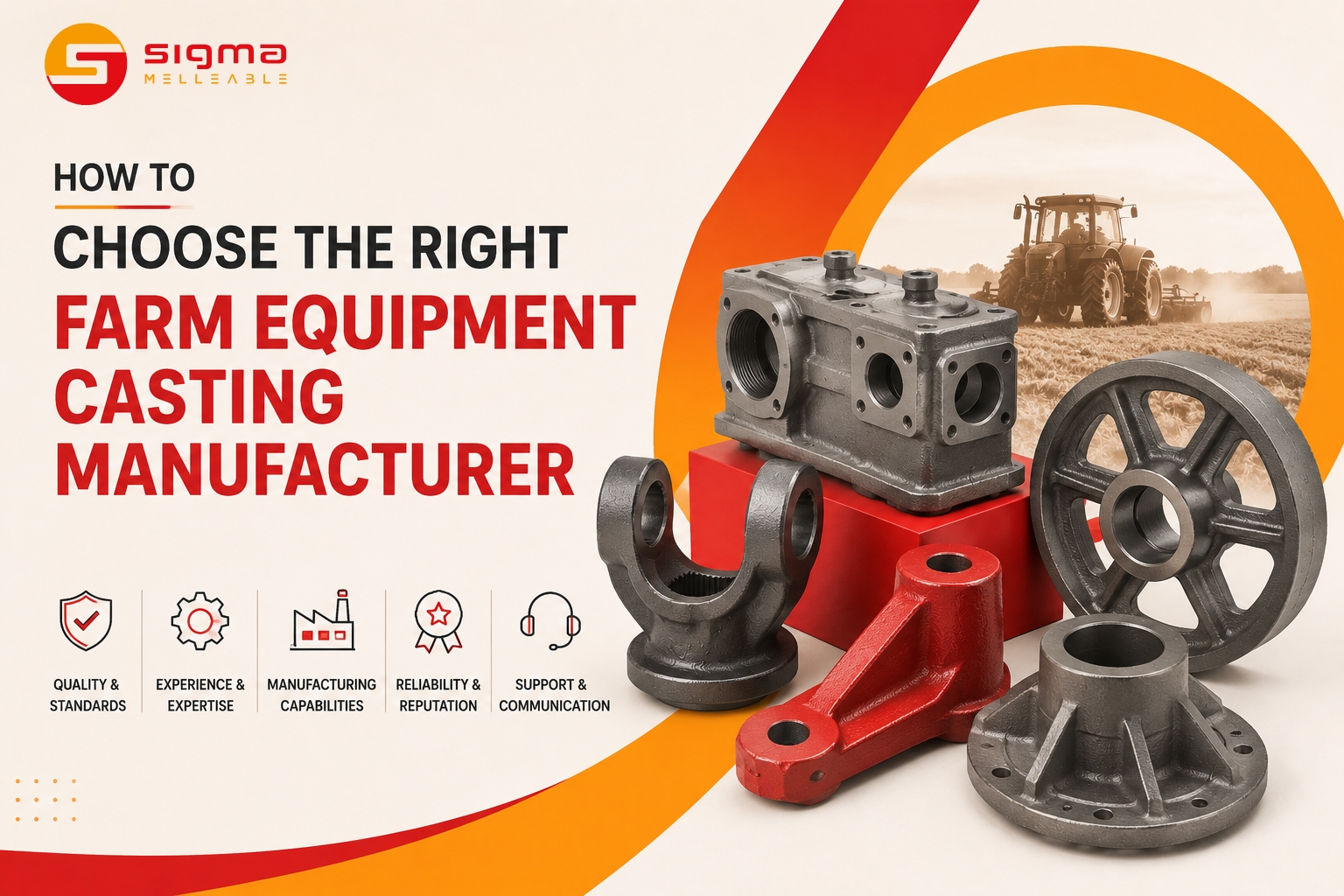
How to Choose the Right Farm Equipment Casting Manufacturer
Farm equipment today needs to be highly reliable and able to work in difficult conditions. Be it tractors or harvesters, drills or irrigation machines – each of them should withstand high loads, rough terrain, and continuous use. One of the keys to the durability of the machinery is farm equipment casting. Choosing the right casting manufacturer will not only affect the quality of parts themselves, but also influence the efficiency of the whole equipment.
No matter if you are an OEM, procurement manager, agricultural equipment exporter, or agricultural equipment engineer, choosing a reliable casting partner will be a serious business choice. This article will explain what farm equipment casting is, how the process goes, and what things to take into consideration while choosing a good casting supplier.
What Is Farm Equipment Casting?
Farm equipment casting is a process of producing a metal part by pouring it into the mold and letting the molten metal cool down and harden in the desired form. After that, the casting is cleaned, machined (if necessary), and inspected for further use in agricultural machinery.
It is a very widespread technology since it allows producing complicated shapes with great durability and strength. Materials used for castings include cast iron, ductile iron, and steel. The most common among them are cast iron and ductile iron.
Examples of agricultural machinery castings are:
- Tractor housing
- Gearbox
- Wheel hub
- Axle parts
- Hydraulic parts
- Brackets
- Plough parts
Compared to fabrication or machining from a solid piece of metal, casting technology usually allows more design flexibility, production cost reduction, and good quality in case of mass production.
Why High-Quality Agricultural Machinery Casting Matters
Agricultural machinery usually works in quite rough conditions. It is dust, mud, moisture, vibrations, and heavy loads that constantly affect the equipment. In this case, poor-quality castings may crack, wear faster, or even fail unexpectedly.
There are several benefits of high-quality agricultural machinery casting:
- Increased durability under heavy operating conditions
- Better wear resistance and longer lifetime
- Reduced costs of maintenance and repairs
- Higher level of safety
- Reliable performance through the entire period of equipment’s operation
Investment in high-quality castings by the manufacturer will help to decrease the number of warranty claims and customer dissatisfaction.
Common Parts of Farm Equipment Produced By Casting
There are many crucial parts of agricultural equipment produced with the help of farm machinery casting due to the increased strength and design possibilities of this technology.
Here are some examples of agricultural equipment parts produced by casting:
Tractor parts casting (transmission housing and differential case)
- Plough frame and blade
- Cultivator parts
- Harvesting machine parts
- Seed drill assembly
- rrigation pump housing
- Wheel hub
- Gear housing
- Hydraulic valve body
- Mounting bracket
- Axle support
Such parts need to have accurate dimensions and material parameters to operate smoothly in field conditions.
Stages of Farm Equipment Casting
1. Product design
Engineers develop CAD models and define material specifications depending on strength and performance requirements of the application.
2. Pattern making
The pattern, corresponding to the final product, is made.
This pattern will serve as a mould cavity during the casting process.
3. Mould preparation
Moulding sand is packed around the pattern, creating a precise mould that is able to contain molten metal.
4. Metal melting
The chosen material is melted in the furnace at the specified temperature, maintaining the right chemical composition.
5. Pouring
The molten metal is poured into the prepared mould using special methods of pouring to avoid possible defects.
6. Cooling and solidification
The metal casting cools down naturally, becoming hard.
7. Fettling
Excess metal, gates, and risers are removed; the casting is cleaned.
8. Machining
If necessary, critical dimensions are machined to make sure they meet engineering tolerance.
9. Inspection
Quality control is performed, including dimensional and visual inspection and material testing to confirm that all specifications are met.
10. Finishing
If necessary, the casting receives surface treatment, coating, or painting before shipment.
Each stage is important to produce reliable and durable parts.
Cast Iron vs. Ductile Iron for Farm Equipment
Choosing the right material is equally important to choosing the right manufacturer.
Cast Iron Farm Equipment Parts
Cast iron farm equipment parts have great advantages because of wear resistance, vibration damping, and lower price.
Ductile Iron Casting for Farm Equipment
Ductile iron casting is characterized by higher strength, flexibility, and impact resistance compared to cast iron. Ductile iron is especially effective when manufacturing components that are subjected to heavy loads and continuous operation (such as axles and transmission housing).
The choice of material depends on operating conditions, loads, and service life of the part.
10 things to check when choosing a farm equipment casting manufacturer
There are several criteria you need to consider when selecting a farm equipment casting manufacturer.
1. Experience
The experience of the manufacturer proves its familiarity with the peculiarities of the agriculture industry and possible performance problems.
2. Manufacturing capacity
Check whether the supplier can provide enough products without compromising quality and deadlines.
3. Materials range
The supplier must have a range of different materials (cast iron and ductile iron), being able to recommend the most suitable one depending on your application.
4. Quality control
Quality control includes documented inspection procedures, testing equipment, and traceability during production.
5. Precision engineering
Precision farm equipment casting is important to ensure proper fit of parts and better machine performance.
6. Advanced manufacturing equipment
Modern equipment, such as advanced moulding systems, machining centers, and inspection equipment, improves manufacturing quality and increases efficiency.
7. Quality certifications
Certified manufacturers prove their commitment to standardized manufacturing processes.
8. Custom manufacturing
Often OEMs need custom farm equipment casting.
9. Consistent delivery
Reliable delivery helps manufacturers to avoid production delays and organize inventory.
10. Technical support
Good communication between customer and manufacturer makes project management easy from design to delivery.
Questions to Ask When Choosing a Farm Equipment Casting Supplier
When choosing a farm equipment casting supplier, you should ask such questions as:
- Which industries do you operate in?
- What materials do you specialize in?
- Do you manufacture custom castings?
- What quality inspections do you conduct?
- Which quality certifications do you have?
- What is the average lead time?
- Do you manufacture both prototypes and large volumes?
- How do you deal with quality problems?
Those questions help to estimate technical skills and reliability of the supplier.
Common Mistakes in Buying Farm Equipment Casting
In most cases, the buying decision is made only depending on the price of the product.
The following mistakes are common:
- Choosing the cheapest producer without estimating quality standards
- Not considering manufacturing capacity
- Ignoring quality inspections and testing
- Not considering communication and technical support
- Not verifying experience in farm equipment casting
Sometimes a little more expensive quality investment can save you a lot in the future due to maintenance cost reductions and fewer failures.
Why precision matters in farm machinery casting
Precision is crucial for proper performance of the machinery. Low dimensional accuracy leads to assembly problems, excessive wear, vibration, and machine failures.
High-quality precision farm equipment casting ensures:
- Proper component fit
- Better performance of the machine
- Reduction in downtime
- Increased durability of equipment
- Reduction in maintenance costs
Precise casting simplifies machining and assembly, thus helping manufacturers increase efficiency.
Why Sigma Melleable is a trusted farm equipment casting manufacturer
When selecting an agricultural machinery casting company, manufacturers pay attention to experience, consistency, and reliable manufacturing practices.
Sigma Melleable specializes in precision manufacturing with strict quality control in the whole production process. This company provides custom farm equipment casting solutions designed according to customers’ needs and produces durable cast iron products and ductile iron castings for farm equipment.
The experienced workforce, reliable manufacturing practices, timely delivery, and customer-oriented attitude are the main advantages of Sigma Melleable. Thus, the company successfully supports OEMs and industrial buyers in their consistent production.
Conclusion
The choice of a reliable farm equipment casting manufacturer guarantees quality of products and successful business activity.
A reliable manufacturer has material expertise, advanced production equipment, quality control, and good customer support to provide reliable components for agricultural conditions.
If you are searching for a reliable casting solution for agricultural machinery, Sigma Melleable will be glad to help you with it. Whether you need standard parts or a custom casting solution, cooperation with an experienced manufacturer is a guarantee of the product’s quality and success in your production.
FAQ
What is farm equipment casting?
It is a manufacturing process of agricultural machine components based on pouring molten metal into molds to obtain strong and durable components.
Which material is best for tractor parts casting?
Both cast iron and ductile iron are widely used. The best material depends on the required strength and wear resistance.
Why is ductile iron used in agricultural machinery?
Due to its high strength, toughness, and impact resistance.
How do I choose a farm equipment casting manufacturer?
Consider experience, quality control, certifications, manufacturing capacity, materials range, and customer support.
What industries use agricultural equipment casting?
Ag machinery manufacturers, tractor manufacturers, irrigation equipment producers, and OEM suppliers use cast components.
What is precision farm equipment casting?
This term refers to the process of manufacturing precise cast components with the purpose to improve their fit and performance.
How long do cast iron farm equipment parts last?
With appropriate material choice and maintenance, high-quality cast iron parts can serve for many years.
Can manufacturers provide custom farm equipment casting?
Yes. Most manufacturers can provide custom casting solutions according to customers’ drawings and specifications.
Contact Sigma Melleable
Looking for dependable farm equipment casting solutions for your next project? Contact Sigma Melleable to discuss your casting requirements, request technical guidance, or explore custom manufacturing options.
Phone: +91 99093 80133
Email: info@sigmamelleable.com
-
What is Connector Valve Casting? Complete Guide for Industrial Applications
-
How to Choose the Right Farm Equipment Casting Manufacturer
-
Valve Body Casting: Complete Manufacturing Guide for Industries
-
What Is Valve Casting? - Beginner Guide
-
How to Pick the Right Cast Iron Fitting for Your Project
-
Essential Submersible Pump Motor Parts: Lower Manifold, Upper Manifold & Discharge Head