
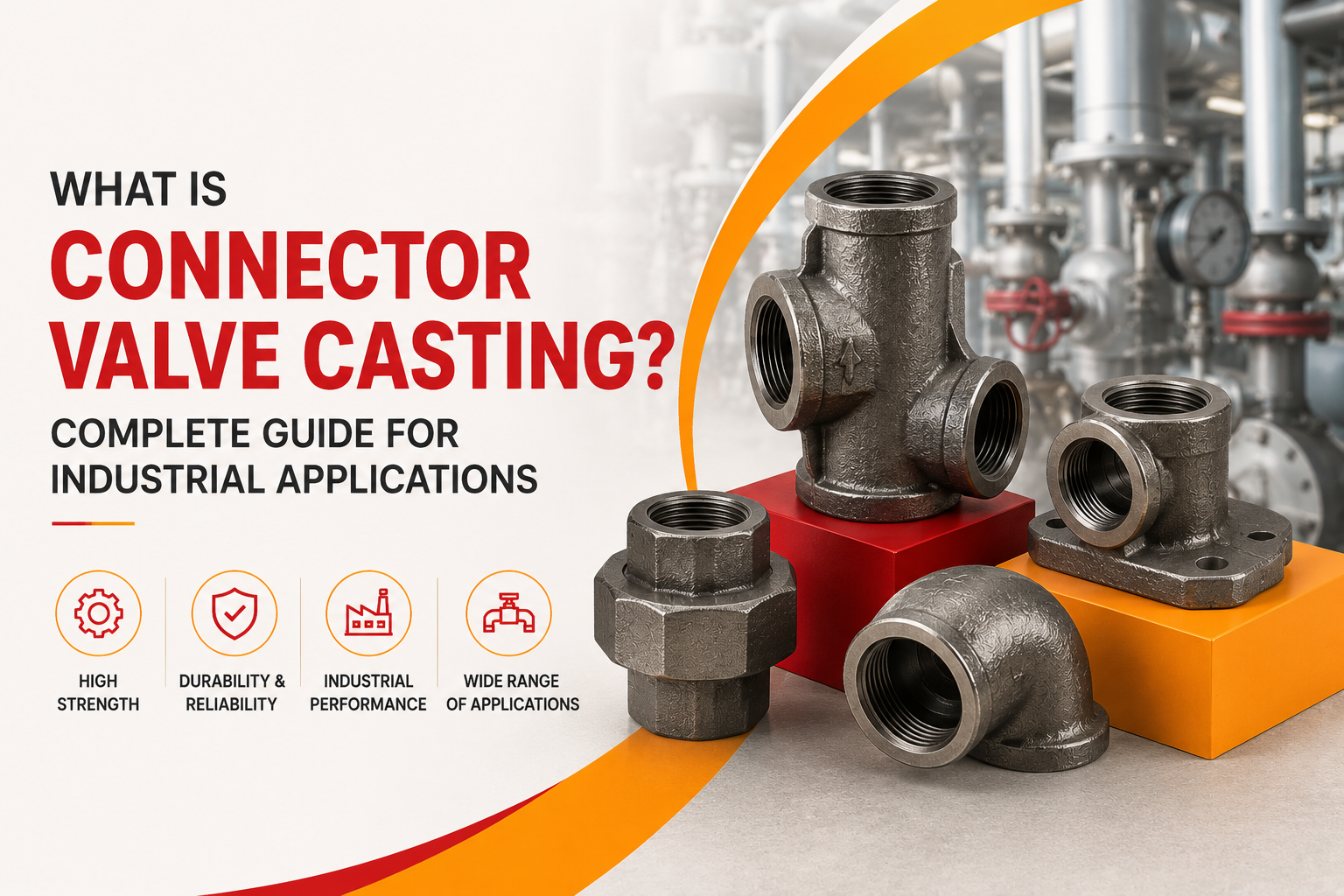
What is Connector Valve Casting? Complete Guide for Industrial Applications
Modern industries widely use industrial connector valves. These valves help to regulate, direct, and control the flow of liquids, gases, and steam. These products are used in water treatment plants, chemical processing industries, oil refineries, manufacturing units, and many other industrial areas. As a rule, industrial connector valves have to work under high pressure and difficult environmental conditions. Their durability depends both on the design and casting technology.
Therefore, connector valve casting is an important industrial process. High-quality casting provides durable and reliable valve parts that can withstand pressure, different temperatures and corrosive environments. Appropriate choice of casting technology and material helps to increase operational efficiency, decrease maintenance expenses, and reduce downtime.
This guide tells you what connector valve casting is, what the production process looks like, what materials are used, industrial applications, and what to look for when choosing a good manufacturing company.
What Is Connector Valve Casting?
Connector valve casting is the process of manufacturing valve connectors and other valve parts through pouring liquid metal into specially designed molds. When the metal solidifies, the casting is machined and polished in order to get the necessary characteristics.
Connector valves are used to connect, regulate, and separate the flow of liquid in industrial pipelines. As these parts are subject to pressure, vibrations, and tough working conditions, they have to be resistant enough to pressure and wear.
Casting is one of the most preferred manufacturing methods because of its ability to manufacture complex-shaped parts with high efficiency. Besides, this process guarantees great structural stability that makes it appropriate for industrial application.
Some industries that use industrial connector valve casting are:
- Oil and gas
- Water treatment
- Power generation
- Chemical processing
- Fire protection systems
- Agriculture
- Mining
- Marine engineering
- HVAC
- Industrial manufacturing
How Does the Connector Valve Casting Process Work?
A well-regulated process of connector valve casting helps to manufacture high-quality valve components.
Pattern Making
The first step is to make a pattern, which is an exact copy of the valve component. A good pattern is very important in terms of obtaining accurate and stable castings.
Mold Preparation
Using the pattern, manufacturers prepare molds from special materials that are able to withstand high temperatures without deformation.
Metal Melting
Iron or ductile iron metals are melted at high temperatures. At this stage, the composition of the metal is controlled in order to get the necessary mechanical properties.
Pouring
The metal is poured into prepared molds in accordance with certain rules in order to eliminate any possible defects.
Cooling and Solidifying
The metal is cooled down gradually with the formation of a stable grain structure and reduction of internal stress. Controlled cooling is very important for manufacturing reliable valve parts.
Fettling
After solidifying, all the extra metal, gates and runners are removed from the casting. Fettling also includes the thorough cleaning of the casting before machining.
Precise Machining
Important sealing surfaces, threads, holes and connection places are machined precisely. This step is very important in terms of providing performance and reliability of precision valve castings.
Surface Finishing
The processes of shot blasting, grinding, and coating are used in order to increase surface finish, corrosion resistance, and aesthetic look of the part.
Inspection and Quality Control
All the castings undergo a strict inspection procedure, which includes such stages as:
- Visual inspection
- Verification of dimensions
- Pressure testing
- Material analysis
- Non-destructive testing (if necessary)
Such strict control provides the highest quality of precision connector valve castings that will reliably work in demanding industrial conditions.
Top of Form
Bottom of Form
Materials Used in Connector Valve Casting
There are various considerations when choosing the material used in connector valve casting. This ensures optimal reliability, longevity, and maintenance-free service.
Cast Iron Connector Valve
Cast iron connector valve is one of the most commonly used materials in connector valves owing to its ease of molding, cost-effectiveness, and compressive strength. This makes it an ideal choice in various applications requiring moderate pressure performance.
Advantages
- Economical manufacturing process
- Good resistance to wear
- Damping vibrations
- Machinable
- Moderate pressure performance
Applications
- Water supply
- HVAC systems
- Irrigation
- Municipal use
- General industry services
Ductile Iron Connector Valve
This type of connector valve offers high tensile strength and impact resistance due to the special graphite composition. This means that this material is better suited to industrial applications and high-pressure applications.
Advantages
- Strength
- Better ductility
- Pressure resistance
- Increased fatigue life
- Shock loading resistance
Applications
- Oil & gas pipelines
- Chemical industry
- Fire protection systems
- Industrial machinery
- High-pressure fluid handling systems
Cast Iron vs. Ductile Iron
|
Feature |
Cast Iron |
Ductile Iron |
|
Strength |
Moderate |
High |
|
Ductility |
Low |
Excellent |
|
Pressure Handling |
Medium |
High |
|
Impact Resistance |
Moderate |
Excellent |
|
Machinability |
Very Good |
Good |
|
Cost |
Lower |
Slightly Higher |
|
Typical Applications |
Water, HVAC |
Oil & Gas, Chemical, Mining |
Key Benefits of Precision Connector Valve Casting
High-quality precise connector valve casting has a variety of advantages, which is why it is popular in challenging industrial applications.
Durability
Valves that have been cast are made in such a way as to be able to work in challenging industrial conditions all the time.
Strength
Correct selection of metal alloys provides castings with the necessary mechanical strength to perform well in heavy-duty applications.
Prevention of Leaks
Precise machining and exact dimensions result in better sealing of surfaces and help avoid leakage.
Corrosion Resistance
Selection of materials and surface protection improve corrosion resistance of the valve.
Exact Dimensions
Precise casting ensures dimensional consistency and helps avoid unnecessary machining and good fitting of the parts during assembly.
Cost Effectiveness
Casting makes it possible to produce complex designs economically and save on production costs.
Increased Lifespan
Well-made valve castings need little maintenance and work reliably for a long time.
Resistance to High Pressures
Precisely made castings are resistant to high pressures and temperature changes.
Industrial Uses of Connector Valve Casting
Connector valve casting finds application in numerous industries that rely on reliable fluid control.
Oil and Gas
Industrial valve castings are used for regulating the flow of crude oil, natural gas, and other process fluids under high pressure.
Water Treatment
In order to provide efficient flow control, municipal and industrial water treatment plants require durable connector valves.
Chemical Industry
In chemical plants, corrosion-resistant valve components are required to handle aggressive chemicals and challenging process conditions.
Power Plants
Steam systems rely on precision-engineered valve castings to provide stable performance under high temperatures and pressure.
Agriculture
Irrigation systems use connector valves to control the flow of water efficiently.
Fire Fighting Systems
For the reliable functioning of the emergency water network, reliable valve castings are required.
Marine Industry
The marine industry requires durable valve components that will withstand continuous exposure to water and challenging industrial conditions.
Mining Industry
The mining industry uses heavy-duty connector valves for such applications as transportation of slurry and water management, mineral processing, etc.
HVAC Systems
High-quality valve components are needed for efficient and reliable fluid control in heating, ventilation, and air conditioning systems.
Manufacturing Industries
Various manufacturing facilities across different industries use industrial connector valve castings in production equipment, machinery and process systems.
Importance of Quality Valve Castings
Valve failure may cause disruptions in production, lead to increased maintenance costs, and pose a risk to safety. High-quality valve castings prevent these issues, providing reliable performance of the components over their entire service life.
Quality valve castings provide:
- Increased operational safety
- Pressure resistance
- Dimensional accuracy
- Reduced maintenance needs
- No leakage
- Increased lifespan of equipment
- Compliance with industrial standards
Investment in high-quality manufacturing will not only increase the reliability of the plant but also decrease its overall cost.
Choosing the Best Connector Valve Casting Manufacturer
Selection of the right valve casting manufacturer is important in order to receive quality products.
Buyer’s Checklist
When choosing the manufacturer, make sure that they have:
- Proven manufacturing experience
- Quality control procedures
- Modern foundries and machining facilities
- Expertise in cast iron and ductile iron
- Inspection and precise testing equipment
- Ability to manufacture custom parts
- Enough manufacturing capacity
- Reliability in deliveries
- Technical support
- Compliance with industry quality standards
Work with an experienced valve casting manufacturer and get reliable products that will satisfy your technical requirements.
Reasons to Select Sigma Melleable
If you need a reliable valve casting manufacturing company in India that offers premium castings of the highest quality, Sigma Melleable is what you are looking for. This Indian manufacturer combines years of experience in casting and machining industrial parts with an emphasis on precision and quality.
The company uses precision engineering, manufacturing, and quality control to produce precision industrial castings based on customer requirements. With its advanced manufacturing capacity, Sigma Melleable offers a wide variety of valve components made of different materials and tailored to your application needs.
Thanks to the consistent quality of products, timely delivery, and customer-friendly attitude, Sigma Melleable has become a trusted business partner of OEMs, industrial manufacturers, distributors, and engineering companies, providing them with reliable precision connector valve casting solutions.
Main Points to Remember
About Connector Valve Casting
- Connector valve casting creates precision-made, durable valve parts.
- Cast iron is cost-effective for moderate pressure applications.
- Ductile iron ensures increased strength and pressure resistance.
- Precision manufacturing makes valve castings highly durable and efficient.
- Rigorous testing guarantees full compliance with industry performance standards.
- Collaboration with an experienced manufacturer allows maximizing equipment performance and longevity.
Frequently Asked Questions
What is connector valve casting?
Connector valve casting is the process of manufacturing valve parts through pouring molten metal into special molds and then finishing and inspecting them to guarantee the required quality and performance.
Why is ductile iron used for connector valves?
Ductile iron is widely used due to its excellent tensile strength, ductility, impact resistance, and ability to function under high pressure.
Where are connector valves used?
Connector valves are used in industries including oil and gas, water treatment, chemical processing, power generation, mining, marine, agriculture, HVAC, and industrial manufacturing.
What is the difference between cast iron and ductile iron connector valves?
Cast iron is a cost-effective material suitable for moderate-duty applications, whereas ductile iron provides increased strength and flexibility and higher resistance to high-pressure environments.
How are valve castings tested?
Manufacturers perform such testing operations as visual inspection, dimension control, material check, pressure testing, etc.
How to select a connector valve casting manufacturer?
Select a manufacturer with proven experience in the industry, a strong quality control system, modern foundry and machining capacities, testing services, customization possibilities, and a good reputation of dependable deliveries.
What industries use connector valve castings?
Connector valve castings are widely used in oil and gas, water treatment, power generation, mining, agriculture, fire protection, marine, chemical processing, and manufacturing industries.
Why should I work with a precision valve casting manufacturer?
Precision manufacturing provides reliable dimensional accuracy, better sealing performance, product quality, longevity, and minimized maintenance costs.
Conclusion
High-quality connector valve casting is critical for the proper performance, safety, and reliability of industrial flow control systems. Each step of the manufacturing process from material selection to precision machining and quality inspection determines the durability and efficiency of the final product.
Whatever type of valve castings you may need – cast iron connector valve or ductile iron connector valve – cooperation with a professional manufacturer can help achieve the consistent performance and longevity of your equipment.
Sigma Melleable is the manufacturer of high-quality industrial connector valve castings in India, which is provided by reliable manufacturing and quality control processes.
For more information or to discuss your project requirements:
Phone: +91 99093 80133
Email: info@sigmamelleable.com
-
What is Connector Valve Casting? Complete Guide for Industrial Applications
-
How to Choose the Right Farm Equipment Casting Manufacturer
-
Valve Body Casting: Complete Manufacturing Guide for Industries
-
What Is Valve Casting? - Beginner Guide
-
How to Pick the Right Cast Iron Fitting for Your Project
-
Essential Submersible Pump Motor Parts: Lower Manifold, Upper Manifold & Discharge Head